
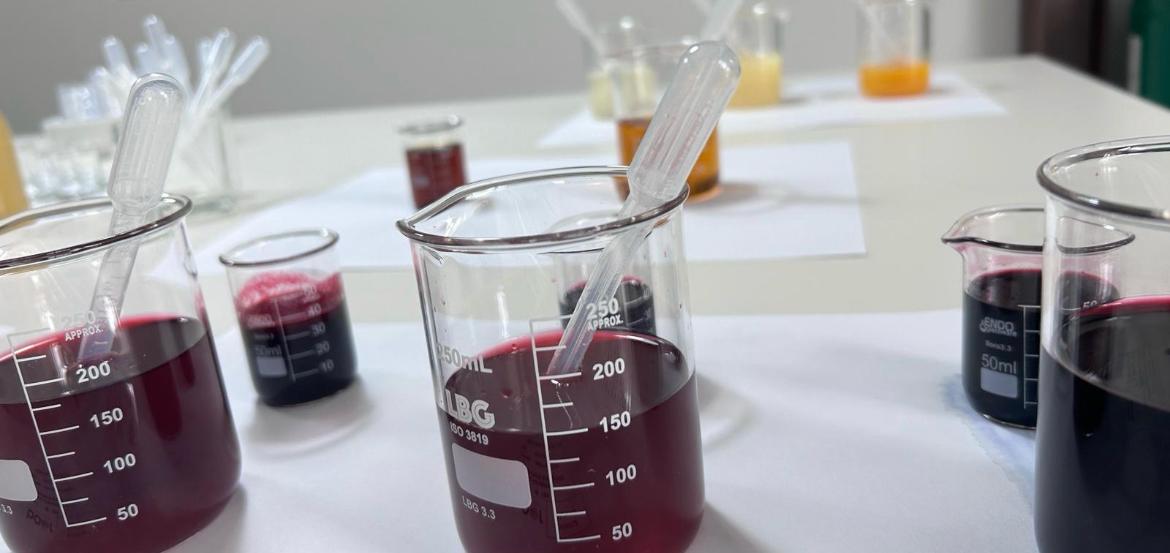
Fructooligosaccharides (FOS) can be incorporated into gummy formulations as part of a fibre-enrichment or sugar-reformulation project. Their use, however, involves more than adding an ingredient to an existing recipe. FOS can affect the balance of solids, moisture and texture, so each formula needs to be assessed as a complete system.
FOS (fructooligosaccharides) is a type of carbohydrate made up of short chains of sugars, mainly fructose units. In food formulation, it can be used as an ingredient that contributes soluble fibre, solids and mild sweetness. Its properties vary depending on its source and commercial grade.
In food products, FOS may be used to:
-Add FOS to a formulation as part of a fibre-enrichment project.
-Partially reformulate the sugar system, although it does not replace all the functions of sugar on its own.
-Contribute solids and modify texture in products such as gummies, dairy products, beverages and bakery goods.
In gummies, FOS is not a gelling agent and does not replace gelatin or pectin. It can affect hardness, elasticity, moisture and water activity, so the complete formulation needs to be tested. Studies on gummies and pectin jelly candies confirm that these effects depend on the recipe and the ingredients being replaced.
Before selecting an addition level, define what FOS is intended to do. Is the objective to increase the fibre content, replace part of the sugar, or develop a new product concept?
These are different formulation goals. Using FOS as an addition and using it to replace part of the sugar system will not necessarily produce the same results. The choice of FOS grade and the ingredients it replaces also matter.
The gummy’s structure still depends on its gelling system, such as gelatin or pectin, and on the conditions required for that system to work. FOS should therefore be evaluated alongside the selected gelling agent, sweeteners, acids, fruit ingredients and processing conditions.
When working with pectin, for example, the formulation must continue to meet the gelation requirements of the specific pectin type. FOS is not a substitute for the gelling agent.
Adding FOS may change the finished gummy’s hardness, chewiness, springiness, stickiness or moisture behaviour. The direction and size of these changes depend on the full formulation.
Research on gummy and pectin jelly candy formulations has found that FOS and other sugar-replacement ingredients can affect texture and physicochemical properties. The findings also show why results from one recipe should not be treated as a universal formula: the ingredient combination and replacement levels influence the outcome.
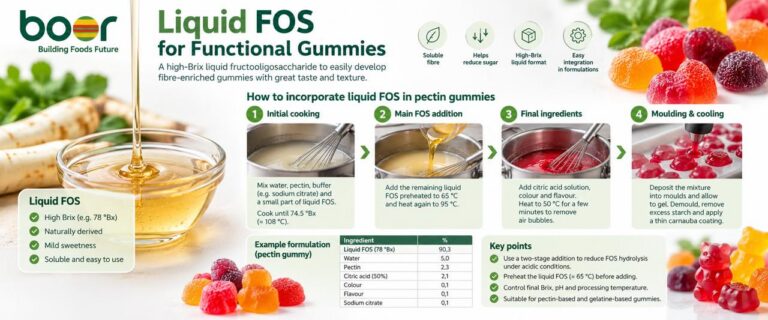
The high-Brix liquid presentation allows FOS to be incorporated directly into the formulation, contributing both soluble dietary fibre and soluble solids while limiting the amount of additional water required.
For pectin-based gummies, a two-stage incorporation process is recommended:
Initial cooking: Use a small proportion of liquid FOS together with water, pectin and a buffering agent. Cook this mixture until the desired soluble solids concentration is reached.
Main FOS addition: Preheat the remaining liquid FOS to approximately 65°C and incorporate it after the initial cooking stage, limiting its exposure to prolonged heating.
Final adjustment: Add the citric acid solution, flavourings and colourings during the final stages, before depositing the mixture into moulds.
This approach is designed to minimise FOS hydrolysis during processing, particularly under the acidic conditions required for pectin gelation.
As a formulation reference, a documented gummy application uses a 78° Brix liquid FOS syrup at approximately 90% of the total formulation, combined with pectin, water and citric acid.
Important: Processing conditions, final Brix, pH and ingredient ratios should be adjusted according to the FOS specification, pectin type and manufacturing equipment.
A practical development trial should compare a control recipe with several FOS levels. Change one variable at a time wherever possible, and record the effect on:
– Cooking and depositing behaviour
-Final solids and moisture
-pH and water activity
-Texture, including hardness and elasticity
-Stickiness, syneresis and appearance during storage
-Flavour and consumer acceptance
The finished product should also be assessed after storage, because a gummy that performs well immediately after production may change in texture or moisture over time.
For manufacturers, the most reliable approach is to treat FOS as one part of the formulation system: define its role, run controlled trials and validate the final gummy’s texture, stability and labelling.
Developing a gummy with FOS? Contact our team to discuss fruit concentrate and formulation options for your confectionery project.
WE DISTRIBUTE OUR PRODUCTS PROVIDING THE NECESSARY PACKAGING ACCORDING TO THE NEEDS OF OUR CUSTOMER




As a leader in fruit and vegetable juices and concentrates, we stand out for our excellence and innovation. Our products are 100% plant-based, sustainable, and of the highest quality.
As international manufacturers and distributors, we guarantee safe and timely deliveries. We work with you to drive your business’s success through solutions that are fully customized and tailored to your company.
Trust Baor to help you achieve your goals and enjoy a partnership built on passion and reliability.
Contact us today to discover how our fruit concentrate bases can elevate your culinary vision to new heights.

All our products are stored at the appropriate temperature in state-of-the-art refrigerated facilities and chambers.

We manufacture and distribute internationally, preserving the cold chain, guaranteeing the quality of each of our products.

Our logistics operations through international operators guarantee the receipt of the product in perfect conditions.