
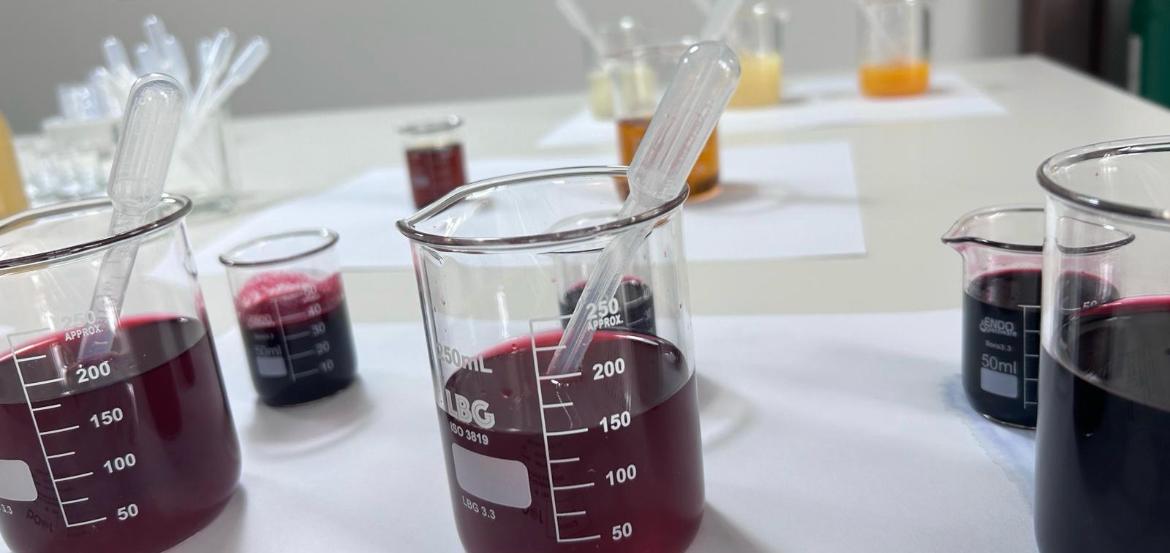
Fruit is commonly associated with gummies through flavour and colour.
But when fruit juice concentrates and fruit bases are incorporated into the formulation, fruit can play a much more important technological role.
A fruit concentrate contributes soluble solids, naturally occurring sugars, organic acids, minerals, colour compounds and characteristic fruit components to the formulation.
This means that adding fruit is not simply a matter of replacing an artificial or natural flavour.
It can affect the entire gummy system:
Fruit concentration → °Brix → sugar profile → pH → acidity → gelation → texture → stability
Understanding these interactions is essential when developing gummies with a significant fruit component.
Fruit juice concentrates typically contain a high concentration of soluble solids, primarily naturally occurring fruit sugars together with acids and other soluble fruit components.
When incorporated into a gummy formulation, these solids become part of the overall solids balance.
This is particularly important because gummy texture depends strongly on the relationship between water, soluble solids and the gelling system.
The amount of fruit concentrate therefore needs to be considered when calculating the final formulation rather than simply being added as a flavour ingredient.
Increasing the fruit component can change Final °Brix, Water content, Sugar composition, Sweetness, Cooking requirements, Gel texture and Final product stability
For this reason, the fruit ingredient should ideally be considered from the beginning of product development.
Different fruits contain different proportions of glucose, fructose and sucrose.
Consequently, two fruit concentrates with the same °Brix do not necessarily behave identically in a confectionery formulation.
The sugar profile can influence sweetness, solids balance and the physical behaviour of the final product.
It can also influence the tendency of concentrated sugar systems to crystallise.
This becomes especially relevant when manufacturers want fruit to contribute a significant proportion of the soluble solids rather than simply adding a small percentage for flavour.
This is an important distinction.
Instead of designing a gummy entirely around conventional sugar syrups and subsequently adding fruit flavour, formulators can consider the sugars and solids naturally supplied by fruit as part of the formulation from the beginning.
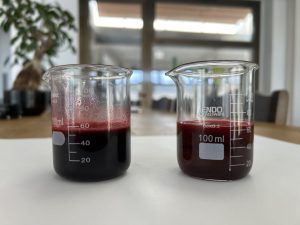
Fruit concentrates naturally contain organic acids.
Depending on the fruit, these may include mainly citric acid, malic acid or combinations of different organic acids.
As fruit concentration increases, its contribution to the acid balance of the gummy also becomes increasingly important.
This directly affects pH and titratable acidity, two parameters that should not be treated as interchangeable.
For the confectionery manufacturer, controlling acidity is important not only for taste.
It can also influence:
gel formation, texture, processing behaviour and product stability.
This is particularly relevant in pectin-based gummies, where the interaction between the selected pectin system, soluble solids, calcium where applicable, pH and processing conditions determines the final gel structure.
Therefore, the natural acidity supplied by the fruit must be incorporated into the formulation strategy.
Pectin is particularly interesting for fruit-based gummies because it allows manufacturers to develop plant-based confectionery while maintaining a strong connection with the fruit concept.
However, there is no universal pectin formulation suitable for every fruit base.
Different pectin systems gel through different mechanisms and therefore have different requirements regarding soluble solids, pH, calcium and processing conditions.
Introducing a concentrated fruit base changes several of these variables simultaneously.
For this reason, when increasing fruit content, manufacturers may need to adjust the gelling system rather than simply maintaining the original gummy recipe.
The objective is to find the correct balance between:
fruit solids + water + sugar system + acidity + gelling system
to obtain the required texture.
Fruit concentrates can also be incorporated into gelatin-based gummies.
In this case, the formulation strategy is different because gelatin forms a thermoreversible protein gel.
Acidity, processing temperature, fruit composition and the point at which different ingredients are incorporated need to be considered carefully.
Some fruits also contain naturally occurring proteolytic enzymes.
Fresh pineapple, for example, naturally contains bromelain, which can interact with proteins. However, enzyme activity depends strongly on the processing history of the fruit ingredient and may be reduced or inactivated by thermal processing.
Consequently, the behaviour of the actual industrial fruit ingredient should be evaluated rather than assuming that every pineapple-derived ingredient will behave in the same way.
Working directly with individual fruit concentrates provides manufacturers with considerable formulation flexibility.
But another approach is to use a pre-formulated concentrated fruit base.
A fruit base can be developed with a defined target for parameters such as:
°Brix, acidity, fruit profile, colour, flavour intensity and processing behaviour.
This can simplify subsequent product development because part of the fruit system has already been standardised before it enters the confectionery formulation.
For manufacturers developing multiple products, the same concept can also become a platform for different applications.
A pineapple fruit base, for example, could become the starting point for a range of tropical gummies by combining it with different fruits or functional ingredients.
This is perhaps the most interesting formulation question.
The objective does not necessarily need to be replacing every conventional ingredient.
Instead, manufacturers can investigate whether fruit can perform more than one function simultaneously.
A concentrated fruit ingredient may contribute:
fruit identity + soluble solids + naturally occurring sugars + acidity + colour + flavour
This can potentially reduce the formulation’s dependence on ingredients whose only purpose is to provide one of those functions.
The extent to which this is possible depends on the fruit, desired fruit content, gelling technology, manufacturing process and final product specifications.
Therefore, the correct question is not:
“How much fruit concentrate can we add to our existing gummy?”
A more useful formulation question is:
“How can we design the gummy around the fruit?”
That change in approach creates significantly more possibilities for product development.
BAOR Products develops concentrated fruit ingredients and fruit-based solutions for industrial food and beverage manufacturers.
For a practical example, discover our 100% Fruit Pineapple Base for Gummies & Confectionery.
WE DISTRIBUTE OUR PRODUCTS PROVIDING THE NECESSARY PACKAGING ACCORDING TO THE NEEDS OF OUR CUSTOMER


As a leader in fruit and vegetable juices and concentrates, we stand out for our excellence and innovation. Our products are 100% plant-based, sustainable, and of the highest quality.
As international manufacturers and distributors, we guarantee safe and timely deliveries. We work with you to drive your business’s success through solutions that are fully customized and tailored to your company.
Trust Baor to help you achieve your goals and enjoy a partnership built on passion and reliability.
Contact us today to discover how our fruit concentrate bases can elevate your culinary vision to new heights.

All our products are stored at the appropriate temperature in state-of-the-art refrigerated facilities and chambers.

We manufacture and distribute internationally, preserving the cold chain, guaranteeing the quality of each of our products.

Our logistics operations through international operators guarantee the receipt of the product in perfect conditions.