




14 Feb Strawberry Concentrates: Types, Brix Levels and Industrial Applications
Strawberry concentrates are standardized fruit ingredients obtained by removing part of the natural water content from strawberry purée through controlled evaporation some of those food ingredients also include natural ingredients that upgrade flavor taste and stability of the product. This process increases soluble solids (°Brix), enhances microbiological stability, reduces transport volume, and improves formulation efficiency.
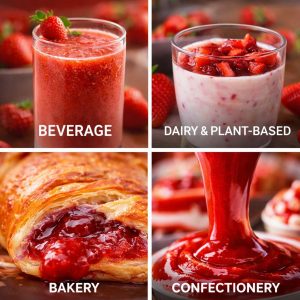
In industrial food manufacturing, strawberry concentrates are widely used in beverages, dairy, bakery and confectionery applications due to their consistent flavor profile, natural color, and scalable logistics advantages.
The key differentiating factor between strawberry concentrates is the Brix level, which directly impacts viscosity, sweetness, stability, and formulation flexibility.
What Does °Brix Mean in Strawberry Concentrates?
°Brix measures the percentage of soluble solids (mainly natural sugars) present in the concentrate.
Higher Brix = higher concentration = lower water content.
In strawberry processing, the most common industrial levels are:
18–21° Brix
32° Brix
60–65° Brix
Each level serves a specific technological and commercial purpose.
Types of Strawberry Concentrates by Brix Level
Strawberry Concentrate 18–21° Brix
Concentration Level: Medium
Best for: Beverage standardization and balanced fruit intensity
Advantages:
Easier formulation adjustments
Moderate viscosity
Cost-efficient logistics vs single strength
Good balance between intensity and flexibility
Typical Applications:
Fruit drinks
Smoothies
Dairy preparations
Light fruit bases
This format is often chosen when manufacturers need adaptable soluble solids without excessive viscosity.
Strawberry Purée Concentrate 32° Brix
Concentration Level: Standard industrial
Best for: Structured fruit preparations
Advantages:
Higher stability
Improved transport efficiency
Stronger flavor concentration
Reduced water activity
Typical Applications:
Yogurt fruit preparations
Ice cream
Bakery fillings
Syrups and toppings
32° Brix is one of the most widely used industrial standards due to its balance between intensity and processability.
Strawberry Concentrate 60–65° Brix
Concentration Level: High
Best for: Maximum flavor intensity and bulk transport efficiency
Advantages:
High soluble solids
Significant logistics savings
Strong sensory impact
Extended shelf stability
Typical Applications:
Beverage reconstitution
Flavor bases
Industrial syrups
High-intensity formulations
This format is preferred when concentration efficiency and flavor density are priorities.
Strawberry Concentrate with Seeds
Unlike filtered concentrates, this format preserves natural strawberry seeds.
Benefits:
Visual authenticity
Premium product positioning
Enhanced texture perception
Applications:
Yogurt layers
Premium desserts
Craft beverages
Artisanal-style products
Industrial Applications of Strawberry Concentrates
Strawberry concentrates are used across a wide range of industrial food and beverage applications. Different Brix levels and textures are selected depending on the final product, processing conditions, and desired flavor intensity.
Below are the main industrial uses of strawberry concentrates in modern food manufacturing.
Beverage Manufacturing
Strawberry concentrate is widely used in the production of soft drinks, juices, syrups, RTD beverages, and flavored waters. A 65° Brix strawberry concentrate allows efficient dosing, stable flavor, and consistent color in industrial beverage lines.
Strawberry concentrates are used for:
Nectars
Soft drinks
Smoothies
Syrups
Flavored waters
Manufacturers adjust Brix levels through reconstitution to meet target formulations.
Dairy & Plant-Based Products
Used in the dairy industry, strawberry purée concentrates are used in yogurts, drinkable yogurts, and dairy desserts. Products with seeds or higher pulp content provide a more natural texture and visual appeal.
Yogurt preparations
Fermented dairy products
Ice cream
Plant-based alternatives
Concentrates improve texture, stability and flavor consistency.
Bakery & Confectionery
Common in:
Fillings
Fruit toppings
Jams and spreads
Confectionery inclusions
Higher Brix levels improve structure and reduce water migration.
Ice cream and frozen desserts
Strawberry concentrates are commonly used in ice cream, sorbets, and frozen desserts. Purée concentrates around 28–32° Brix are ideal for achieving a natural fruit profile and stable color in frozen applications. Ice cream manufacturers often rely on a strawberry concentrate for ice cream to obtain a natural fruit taste and uniform color in their recipes.
Why Manufacturers Use Strawberry Concentrates Instead of Fresh Purée
Compared to single-strength purée:
Reduced transportation cost
Lower storage volume
Improved microbiological stability
Longer shelf life
Standardized formulation performance
For industrial operations, concentrates provide operational efficiency and quality consistency.
How to Choose the Right Strawberry Concentrate
Manufacturers should consider:
Target soluble solids in final product, the Required viscosity, Thermal processing conditions and other matters like the desired sensory intensity or the logistics and storage constraints
Visual requirements (with or without seeds) also depends of the needs of the final product. There are some applications like strawberry puree with sugarhttps://baorproducts.com/strawberry-puree-with-sugar/ that are suitable for multiple industrial application are the main industrial uses of strawberry concentrates in modern food manufacturing. in Baor Products also take care about the market need, and we can sustititute the comon sugar for fruit sugar.
Selecting the correct Brix level directly impacts cost structure and formulation control.
Strawberry concentrates are versatile industrial fruit ingredients that allow food manufacturers to optimize formulation, logistics, and product consistency.
Understanding the differences between 18–21°, 32°, and 60–65° Brix formats enables informed sourcing decisions and improved production efficiency.

Sorry, the comment form is closed at this time.